A few months ago, gripped by baking fever, I purchased Mary Berry's Baking Bible. I quickly decided to embark upon a mission to bake everything in the book, and turn myself from an occasional baker into a bit of an expert. My Grandad Ern was a Master Baker by trade; the man responsible for introducing Danish Pastries to England in fact, and I wish it had occurred to me to spend more time learning from him, rather than simply enjoying the fruits of his effortless labours. This project is almost a way of making amends for that; I'd like to follow in his footsteps (if not in my career, at least as a hobby) and continue the proud heritage of baking in my family.
I credit my friend Rachel with the idea to write a blog about my baking exploits, hoping that there will be more successes than failures as I attempt all 213 of the Queen of Baking's recipes.
So as not to bore the husband with a monotonous diet of sponges, followed by weeks of biscuits, I've decided to tackle the recipes by selecting the first bake from each chapter, followed by the second recipe and so on. I'm not going to pick and choose; I'm determined to face my baking demons and learn how to do everything baking-related, even if the consequences are disastrous!
Everything will be photographed, with comment about how I found baking it, and a husband rating (to be taken with a pinch of salt as he has a very selective cake-tooth).


Saturday, 17 November 2012

29. Classic Sticky Gingerbread

Just out of Bonfire Night season, it seemed appropriate to have a go at this bake, made for visiting friends (and now seasoned cake testers!). I've always liked gingerbread so was looking forward to making and eating this. Unlike the gingerbread I made earlier in my project, this one didn't require the inclusion of porridge oats. I was relieved about that, as I didn't really enjoy the 'chanky' texture produced by the oats in the last recipe. This one just relied on the usual cake mix, plus treacle and golden syrup.

Something that troubled me slightly about the recipe was Mary's description at the beginning - a warning that if it sank in the middle, it would be because you'd been 'a bit heavy-handed with the treacle'. I wasn't sure how that works when you measure ingredients as rigidly as I do, using electronic scales, and when a precise quantity is given in the recipe. What's a girl supposed to do? I followed the recipe; when it first came out of the oven (see above) it was well-risen, but sinkage followed (see right), and it seemed that the treacle was responsible. I felt frustrated by this; what's the point in following a recipe if it dooms you to failure? As if I'd contemplate tinkering with quantities at this stage of my baking career! I did worry that I'd not baked it for long enough, but wasn't convinced by this.

The worst thing that happened was that the cake was quite squidgy in the middle. There are worse cake-crimes, and actually the gooiness was quite nice. Better 'sticky' (as the recipe title dictates) than crumby and dry, surely. Indeed, one of our guests requested a sticky slice from the middle of the cake rather than a piece I labelled as 'more done'. It was quite difficult to slice, with it being quite sticky, but I managed to get it into 16 good-sized squares. We had a slice each cold (forks needed), and then on subsequent days had it warmed up with custard. It tasted great both ways.
Baker's verdict: easy to make; handling golden syrup and treacle is always a bit of a nuisance, but I enjoy the whole 'melting' process. Tasted really, really good. It also kept well: I had my last piece 5 days after baking it. I'd definitely make this again, and maybe reduce the treacle by 50g to see what happens...
Husband rating: 9/10 -  delicious cake, tasty, moist and great with custard warmed up.

Thursday, 8 November 2012

28. Melting Moments

Biscuit time again! These are somewhere between a cake and a biscuit to an extent: there's an egg yolk in them and they looked a bit like little flat sponges when they came out of the oven. There was a distinct 'merging' of the biscuits; 18 per baking tray did seem like a lot, and it's not like you can obtain/use giant baking sheets! These were very easy to make; I interpreted the 'few drops' of vanilla extract my way - what did I think would be needed to make them taste of vanilla? I used my nose as my guide. Making 36 equal-sized portions out of a big ball of dough is always a bit of a challenge, and I don't have much of a head for division. I split the mixture into two - one lump per tray and then worked from there. They were as close to equal in size as I could be bothered to get them! I flattened the biscuits out in the oats rather than rolling them in the oats as balls - none of the oats were sticking that way. It's always satisfying when you find something out for yourself. The biscuits soon baked, the ones on the top shelf a bit browner than the others, but not 'overdone' as far as my novice opinion goes. The paler ones were softer when we ate them, but had more of a biscuit 'snap' after storing for a day. I ran a knife between them while they were still soft to retain a bit of a shape to them - I feared there'd just be a pile of broken biscuits at the end of it if I left it until they'd cooled.
Baker's verdict: tasty, very very tasty. Buttery and light and very edible. Easy enough to make.
Husband rating: 8.75/10. Absolutely beautiful but didn't give them a 10 because they're quite simple. Very moreish. Preferred the ones which were under-baked as they were slightly chewy.

27. Classic Rich Christmas Cake


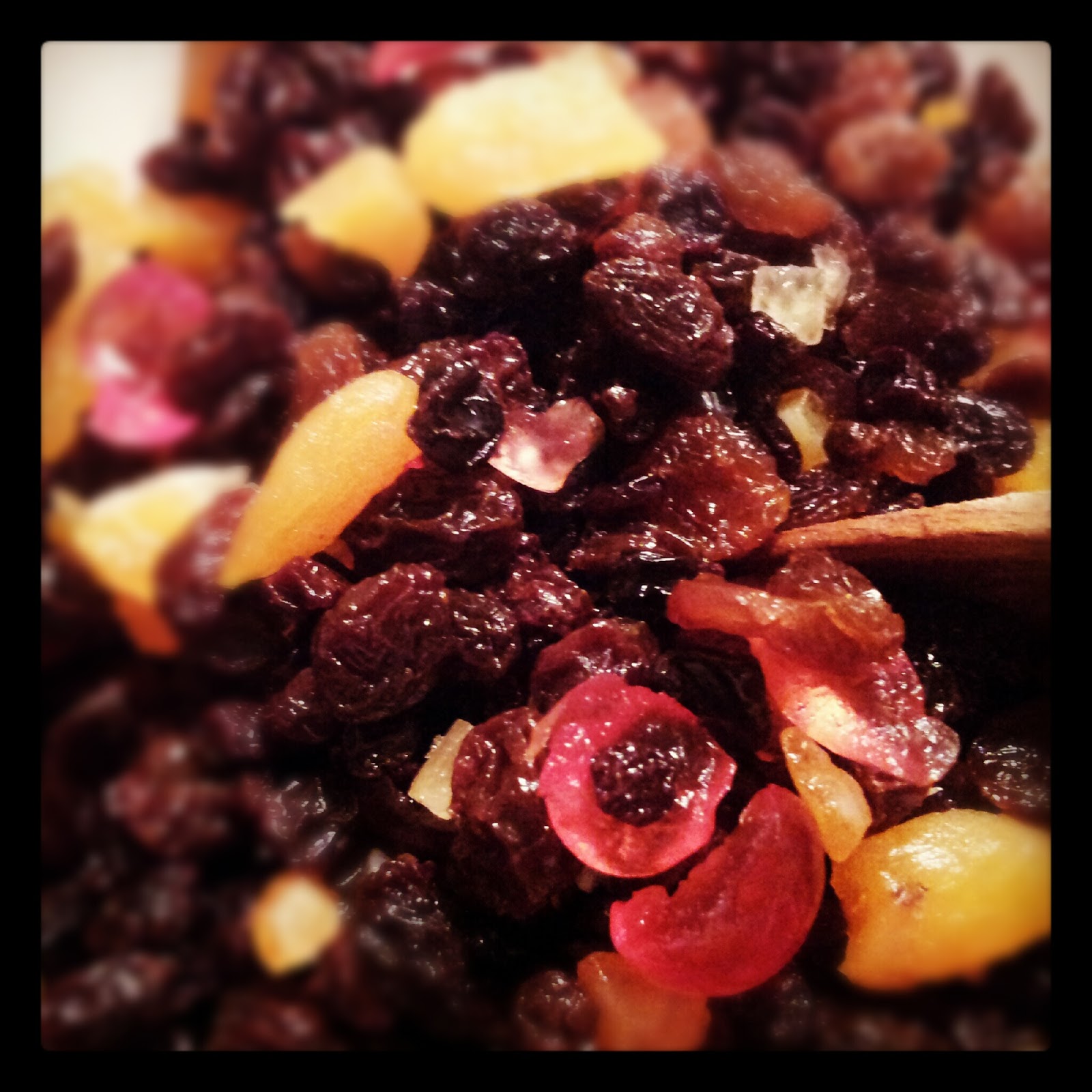
Here it is, my first ever Christmas cake. Baked during the October half-term holiday to allow plenty of 'feeding' time. It happened to be the next fruit cake on my list: I may skip through the chapters to find other Christmas-related bakes while I'm at it though. Anyway, stage one involved getting all the fruit chopped and mixed. There was a lot: raisins, currants and sultanas, as well as apricots, glace cherries and chopped mixed peel. They made a colourful, very festive-looking concoction, eagerly awaiting the 3 tablespoons of brandy to bathe in. My current abstinence from alcohol made this soaking both heavenly and hellish - breathing in those aromas just a little bit of torture but lovely nonetheless!

The fruit had to soak, covered, overnight. By the morning everything had plumped up nicely, and I resisted the urge to pop a boozy raisin into my mouth. Day two involved the cake bit: very straightforward, but physically demanding. My worn-out electric whisk wouldn't have coped with mixing this lot up so it was wooden spoon action all the way. What did make it a bit easier was adding the fruit to the 'wet' ingredients bit by bit. Sometimes there's a danger of the flour not being mixed in properly - this wasn't an issue; I did, however, have my customary butter problems again. I think I need to go one step beyond 'squeezably soft' and whip the butter to a paste before I chuck it in with the other ingredients.

As it was, I just tried to blend in any larger masses of butter as I mixed. There weren't many, and I knew that the baking would help to disperse it further, but I do wonder if it's this (as well as the loose-bottomed tin) which contributes to the buttery leakage at the bottom of the oven. At least I'd predicted this: I put a baking tray beneath the cake-tin to catch the drips. It is frustrating though: surely not that much butter should leak out. Perhaps the cakes are trying to cut our calories for us...
The cake baked for 4 and a half hours and filled the house with the rich aroma of Christmas for a good 2 of them. I don't think there is any better smell, for the warm and fuzzy associations it creates. I wish smells could be bottled and captured forever. The skewer came out clean after that time (the minimum suggested); the cake looked and smelt great, with no hint of charring (a result of covering the cake with some baking parchment). It did flatten the top a bit (my fault for pressing it down and not laying it 'lightly' on top to start with), but this also created some little flaky bits to pick off and nibble!
My blog for this cake needs to pause here, pending comments on the taste etc when we get to Christmas! Six and a half weeks to go...
 
Christmas 2012
 
And now, after two months spent waiting for all that lovely brandy to soak in and work its magic, here we have the finished article! I 'fed' it at the end of November with several tablespoons, and then wrapped it back up; when I unwrapped it on Christmas Eve it smelt lovely, and felt nice and moist. I was a bit of a renegade when it came to the icing, realising too late that you're meant to leave a 24-hour gap between marzipan and icing. I also cheated by buying the ready-made stuff. Mary says it's ok, and life's too short...

I was anxious about the covering of the cake, having never worked with marzipan or royal icing before, but was relieved to find the whole process much simpler than I thought. I had far too much marzipan by the time I'd rolled it out to the required thickness (nice and thin), so Mum and I made some petite fours with the leftovers. I initially forgot to put the apricot jam on, so had to gently lift it off and apply said jam to seal it to the cake. I then left it to 'dry' for a few hours before rolling out and placing the icing. Again, this was easier to work with than expected, and I managed to get a nice smooth finish.

I'd toyed with the idea of messing about with food colouring to get some authentic-looking holly as decoration, and also with buying some edible glitter, but didn't feel especially inspired by what was in the supermarkets. In the end, I thought 'less is more' and just used my new Christmas cutters to cut out some stars and holly (in honour of the two names given to my poorly little cat) and dressed it up with a nice festive ribbon. I was very pleased with the end result; sometimes Christmas cakes can look a bit gaudy in my book!
And so to the taste. I was really pleased with the cake: it retained its moisture and had a lovely flavour, not too overpowering with brandy. It didn't feel dry, or sticky: the texture was just right. I also liked the balance between cake and marzipan + icing. Because I'd kept the layers quite thin, you didn't get a massive sugary hit from the topping, just a nice balance with the cake.
Baker's verdict: this will do nicely as a Christmas cake to make year on year. Enjoyable and straightforward to make and very tasty.
Husband rating: 7.5/10 - great Christmas cake, but I'm not a massive fan of Christmas cake. Tasty, but not my kind of cake.
Mum and Dad rating: 9.5/10 - the only thing which would improve this is bigger pieces of cherry.
Mother-in-Law comment: 'the best I've ever eaten'. 

Tuesday, 6 November 2012

26. Chocolate Victoria Sandwich

At the request of my friend Rachel, who asked for either a Victoria Sponge or a chocolate cake, I rustled this up for afternoon tea. Because of the size of my tins, I had to adapt the recipe slightly (just by using the Victoria Sponge guidelines), but something I was really surprised about was the relatively small amount of cocoa used. It also wasn't sifted in with the other ingredients, but mixed with a little water first - not how I'm used to making a chocolate sponge! Not suprisingly, the cake didn't look very chocolatey when it came out, nor did it smell very chocolatey. Having the Devil's Food Cake as a comparison didn't help, but this (as you can see) was a very pale chocolate cake indeed! It did seem to bake differently compared to the Victoria Sponges I've made - it actually feel apart a bit when I put the buttercream on. I did flip it over a bit on the cooling rack though, trying to keep the indentations off the top of it, and know I shouldn't have done that. Lesson learnt: don't manhandle warm sponges! The filling and topping was just the usual buttercream, with some chocolate grated on top. It tasted nice, but just generically of 'cake'. It didn't feel like a chocolate cake experience to me at all!
Baker's verdict: a good cake, but not a yummy one. Easy to make, but definitely needs more cocoa!
Husband rating: 7/10 - nice sponge cake but nothing chocolatey about it.
 

Sunday, 7 October 2012

25. Devils' Food Cake

I was really excited about baking this; it looked fairly straightforward and was bound to be tasty. The only challenge I envisaged was the frosting: never made 'frosting' before, and it looked fraught with hazard potential! Unfortunately my fears were realised, and this has been one of the few bakes I've done thus far which I've felt genuinely disappointed with. The cake itself was very easy to make, but one of few deviations from the 'all-in-one' method Mary seems to favour. It involved creaming the butter and the sugar together first, before adding the rest of the ingredients.
Also, the cocoa powder was mixed with water before adding to the cake batter; this made for a very wet mixture which would inevitably turn into a moist, fudgy-textured cake. I gave the cake 32 minutes in the oven; it was well-risen and a great colour. When I turned the sponges out of the tins, they were both very dark and sumptuous, and smelt lovely. I then had to leave them to cool right down before preparing the frosting. As it turned out, the art of making the frosting wasn't a difficult one to master, although I did resort to using the electric mixer towards the end as my hand whisking was feeble to say the least.

The mixture consisted of caster sugar, an egg white, a pinch of cream of tartar and some hot water. It had to be continuously whisked over a pan of 'hot water', and here's where the trouble began. For precision baking (such as it is), I need clearer instructions. I used my own judgement and set a pirex dish over a pan of boiled water, set on a medium-low heat. I thought if I retained the 'hotness' of the water, things would be ok. The recipe said nothing about 'boiling' or 'simmering'. So, whisking away to very little avail, I used the electric mixer to get the 'firm' texture described, thinking that the desired texture would be the only issue. It was only when I'd finished whisking that it occurred to me that there might actually be an issue with me testing it, and indeed eating the cake. Being pregnant, raw eggs are an issue, and I wasn't sure if the light 'heating' method was sufficient to constitute cooking the egg white! Otherwise, I'd have tested the frosting at this stage. Anyway, I spread a small amount on to sandwich the cakes together, and then got to work covering the cake all over. I was quite pleased with the end result; there was no picture in the book to work to, but I managed to create the desired 'peaks' and thought it all looked very appetising.
We didn't sample any of the cake until later in the day (after having decided that the egg-white issue probably wasn't anything to worry about) and were met with immediate disappointment. Chocolate cake = lovely; everything it should be. Frosting = shambolic. The sugar hadn't dissolved properly, so the end result was a very grainy and very soft frosting, which didn't match the description of a meringue/marshmallow texture. I'm now left with the dilemma about how to get the cake eaten. Husband and I will have a few slices sans frosting, but to inflict this on colleagues...?
Baker's verdict: I was so chuffed with my efforts here, and subsequently gutted that it didn't turn out so well after all. I'll master this frosting one day: sugar thermometer will be the next investment!
Husband rating: 7/10 for the cake - lovely bit of chocolate cake; 1/10 for the frosting - didn't like it at all because it was grainy - like eating raw sugar!

Saturday, 6 October 2012

24. Classic Apple Pie

I'd been putting this bake off until a suitable occasion presented itself, not because I anticipated that it would be a difficult one. I think pies need guests, so I made it last weekend when my parents were visiting and a pudding was required after the Sunday dinner. It wasn't particularly challenging, but this is probably the last time I'll bake and make dinner at the same time, as I couldn't give it my full attention. It was a pretty basic recipe; I chopped the apples into thick slices and put them into some lemony water to stop them browning, while I made the pastry.
The pastry was a funny one; the first time I've used vegetable fat (like veggie lard) in any recipe. It was the usual case of rubbing the butter and fat into the flour and then binding it all together with water, but it was a bit of a sod to roll out. I couldn't do it without it tearing, but it didn't feel either too dry or too wet to me. It was a faff getting it on top of the apples (which had been sprinkled with sugar and cloves), so I called on the expertise of Mum to help! It then had to chill in the fridge for 30 minutes before baking. Once in the oven (40-45 minutes given as the baking time), it seemed to cook too quickly. After 20 minutes, it needed covering with foil as it was already starting to brown at an alarming rate. I was determined to stick to Mary's instructions, so I left it in the oven while we ate our roast and removed it on the bleep of the timer.
The final result was a bit disappointing. The pastry had held (even the patched-up bits), and was nice and crispy. It tasted very good too. However, the 'thickly-sliced' apples had turned to mush, which I hadn't expected. I don't know if this is how Mary's pie turns out, but the object of slicing the apples in that way was defeated, I feel! A collective theory was that baking the pie in the top oven rather than the larger fan oven meant that it was too close to the heat and cooked too quickly and for too long. I hardly ever use the top oven; on this occasion the chicken was occupying the fan oven (another contributory factor in my decision to keep meal preparation and baking separate).
Baker's verdict: nothing wrong with the taste, and lovely with custard; good pastry, but mushy apples didn't quite do it for me.
Husband rating: 6.5/10. Tasty, but it was a bit like an apple puree with a thin bit of pastry on top (and some burnt bits).

Monday, 17 September 2012

23. Bishop's Fingers

I was desperate to do some baking, feeling thoroughly inspired by 'The Great British Bake Off' again, so I decided biscuits were the order of the day - not too complicated, and not at all time-consuming. This variation on the shortbread theme are the next biscuits on the list, so I've tried to stick to my programme of bakes...ish. These are actually very similar to the shortbread biscuits I've already made, both in terms of ingredients, process and end result. The main difference is the inclusion of almond within the mixture. The dough contains both ground almonds and almond extract, so I was expecting a really almondy flavour. I was disappointed. Again I encountered a vague instruction, with only the principle of 'doing everything by the book' to guide me. So, 'a few drops' of almond extract (yes, extract, so therefore potent) was what I put in - the equivalent of a cap-full. It smelt very nice, and I just trusted that with all the almondy ingredients, almond would be the predominant flavour. As it happened, even with the almonds on top, they really just tasted like shortbread, so if I made them again, I'd put a lot more almond extract in. Texture-wise, they were a bit crunchier than the shortbread, having the traditional biscuity 'snap' I like. I will make them again, as they were so straightforward, and there's something so satisfying about kneading biscuit dough!
 
Baker's verdict: easy to make; disappointed with the lack of almond flavour!
Husband rating: 8/10 - very tasty, very buttery, good texture. Would like to be able to taste the almond though.